Beyond reporting: build a predictive intelligence layer for construction decisions


“This challenge is not focused on carbon reporting or compliance tools. The focus is clearly on predictive and decision-support capabilities.”
🚧 Meet Your Corporate Partner: Maes Bouwwerken (Van Roey Group)
Ready to turn CO₂ data into smarter construction decisions & pitch your solution at the Love Tomorrow Summit on July 23, 2026?
Apply before July 8 2026!
This is our main Corporate Partnering Challenge of the year. Scale-up Flanders brings agile start- and scale-ups together with industry giants to accelerate innovation and strengthen Belgium’s tech ecosystem.
For this edition, Algemene Bouw Maes is looking for a technology partner to help move beyond CO₂ reporting and build the next layer: predictive, decision-driven carbon intelligence in construction projects.
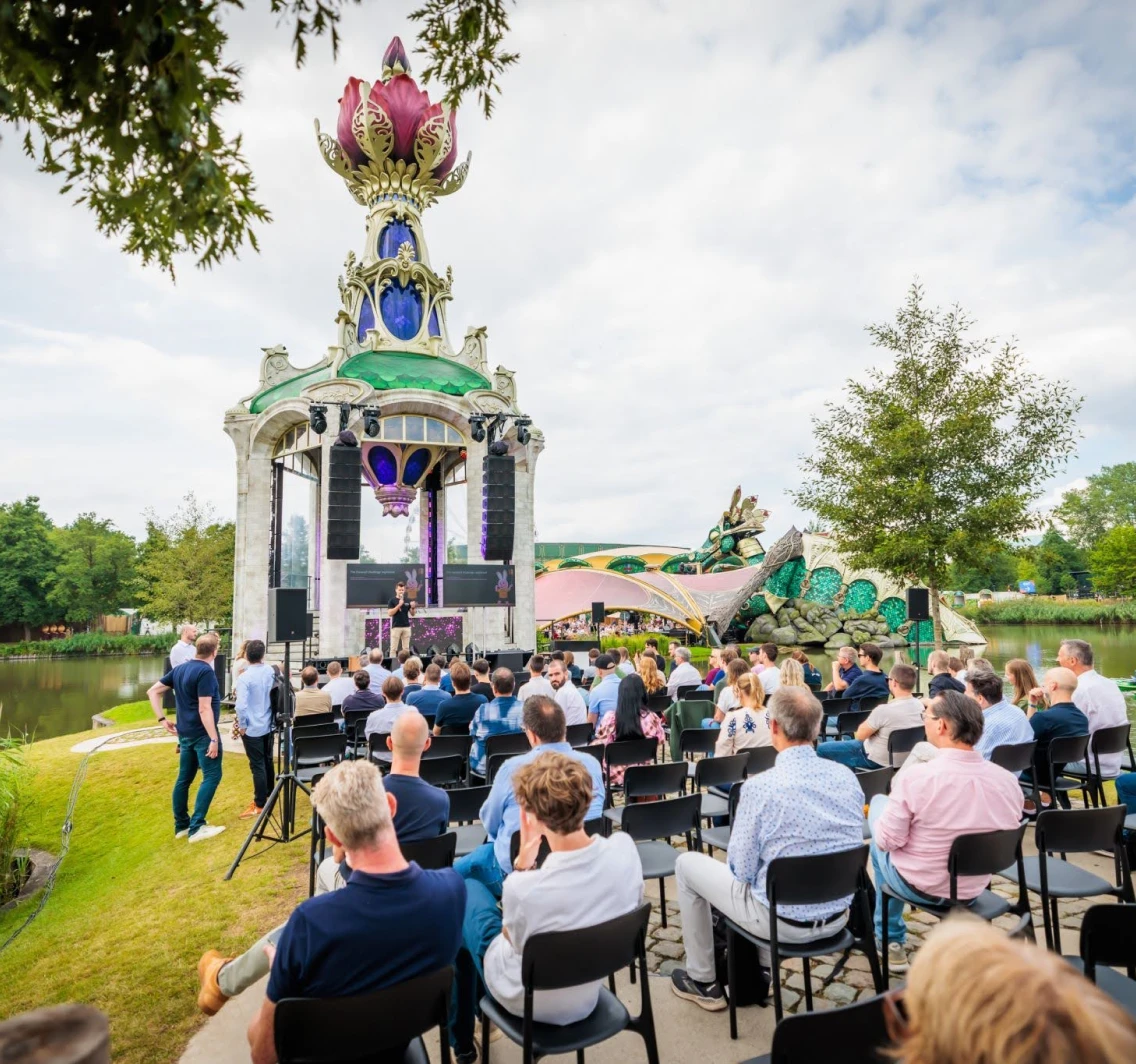
The teams behind the 10 best fitting proposals will be invited to pitch live on stage @Love Tomorrow, on July 23.
After the pitch, Algemene Bouw Maes will work with the winner(s) to assess whether a proof of concept can be set up.
Challenge description
Algemene Bouw Maes already collects CO₂ data across its construction projects (materials, suppliers, activities). Today, this data is mainly used for post-project reporting.
Now Algemene Bouw Maes has the ambition to set up a CO2-intelligence tool/platform that will enable them to:
👉 Use this data upfront
👉 Integrate it into pricing, planning and decision-making on materials, methods and processes
👉 Make CO₂ a core project parameter, alongside cost
What Algemene Bouw Maes is looking for
Algemene Bouw Maes is looking for a partner to co-develop a solution that enables:
- CO₂ prediction during early project phases, that can be used, monitored and updated with real-time data throughout the project
- Translation of CO₂ data into actionable parameters (e.g. per material, per project)
- Integration into existing workflows and systems (including carbon accounting and ERP environments)
Target users
The solution needs to work for a broad and diverse group of users: from project engineers and planners, to IT teams managing the system, to administrative staff at subcontractors responsible for providing input.
👉 This makes ease of use and simplicity not a nice-to-have, but a core requirement.
Current efforts
So far, efforts have mainly focused on CO₂ accounting and post-project reporting.
- CO₂ emission data is collected from suppliers and subcontractors and linked to projects and activity types.
- The option to use accounting tools has been explored and discussed with potential suppliers like Futureproofed, D-carbonize, ClimateCamp, Anthesis, Tapio,...
- In specific cases, tools like TOTEM have been used during construction to optimise materials and reduce CO₂ impact.
Today’s setup comes with a number of limitations:
- Highly time-consuming processes
- Limited benchmarks and reference cases, rather ad hoc approach
- No integrated platform (data is spread across separate Excel files)
- Fragmented data landscape, with inputs coming from different suppliers in varying formats
👉 As a result, significant data is available, but difficult to structure, scale and use for predictive insights.
Expected type of solution
Algemene Bouw Maes is particularly interested in solutions that combine:
- Data structuring & standardisation
- AI based predictive modelling (CO₂ estimation based on historical + parametric data)
- Fit with existing processes in the company (not fully integrated, but a compatible add on/integration via API. A new ERP system (Business Central orKPD ERP system) will be introduced by mid-2027. The choice of this ERP software can be influenced by the requirements of the CO2 prediction model.
- Ability to support multiple stakeholders (incl. suppliers)
- Recommendations to IT on data storage
- Long term partnership and support
Bonus points for:
- Real-time feedback loops during execution
Timing: start with pilot on small scope within 1 year; Full implementation in 2028.
What success looks like
- Reliable CO₂ predictions vs actual emissions
- Reduced manual data handling
- Ease of use for all parties involved
- Seamless fit with existing workflows
Why this matters
Construction is entering a new phase where CO₂ will become as critical as cost. Being future proof is essential for Maes, to be able to handle future legislation changes.
For applicants, this challenge is an opportunity to:
- Work with a leading construction group
- Build a first-of-its-kind predictive CO₂ layer in the sector
- Potentially scale beyond a single company context. A successful implementation with Maes, could potentially by rolled out within the Van Roey group, and beyond.
How to apply?
Interested in this challenge?
Send an email to catherine.vaneeckhaute@agoria.be and frederik.tibau@agoria.be outlining:
- Whether you address the full scope or a specific part of the challenge
- Why your solution and team are a strong fit
- How you would approach the problem in practice
Keep it concise and concrete. We’re looking for clarity over volume.
If you have technical questions or need additional context to better scope your solution, feel free to reach out directly to Siebe Haerkinck, Technical Project Planner
Is your tech company ready to scale up?Learn from experienced speakers and peers
Read next
View all